
The Lunático plates, and others, are designed for been apt to be easily adapted for the use that you wish to give them. That is the reason why we make them in solid aluminum that shows much less machining problems that extruded forms.
We need:
Indispensable :
- A power drill (to be able to drill at low speed). A pillar drill makes the operation easier, but it is not necessary.
- A drill bit for metal of the appropriated diameter (it is better to make the hole a little larger –1 mm for example– than necessary in order to have a certain margin)
Optional :
- Some oil, or even milk for lubricating the drill bit.
- A puncheon and a hammer for marking.
First of all, we measure and mark the position where we want to make the hole. If possible, we make a mark with the punch (a good nail could serve) in the exact point; that will prevent the drill bit to change its position.
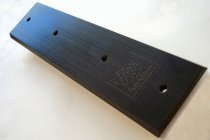
We grip well the plate to a table (using clamps or similar although if the hole is small – of some 5 mm or less – an assistant with gloves may be enough).
We slightly grease with oil (if it is machining oil that is perfect, if not, mineral oil, olive oil, milk… any lubricating agent).
Taking care of putting the drill in a vertical position, and using the mark that we made, slightly putting pressure downwards, we start the drill at a medium/slow speed (the larger the drill bit, the lower the speed).
If the hole is small or the plate is thick it is appropriate to pull the drill back several times, to remove the swarf and to lubricate again. It is usually recommended to pull the drill bit back and to clean it when drilling a length equal to its diameter.
Pay attention when approaching the end of the plate, since the drill tends to block; then it is convenient to put a slighter pressure, at lower speed and to firmly grip the drill.
Safety notes:
- Metal is more difficult to drill than wood or masonry; carry the cautions to extremes, work with smoothness and once drilling, take care for not to excessively accelerate the drill.
- If the supporting table is not a working table it is convenient to place a piece of wood or alike for avoiding boring the table.
- This procedure can be complicated for large drilling bits (say larger than 7mm), since the drill makes much strength in the opposite direction.
- Always use goggles!