The eruption

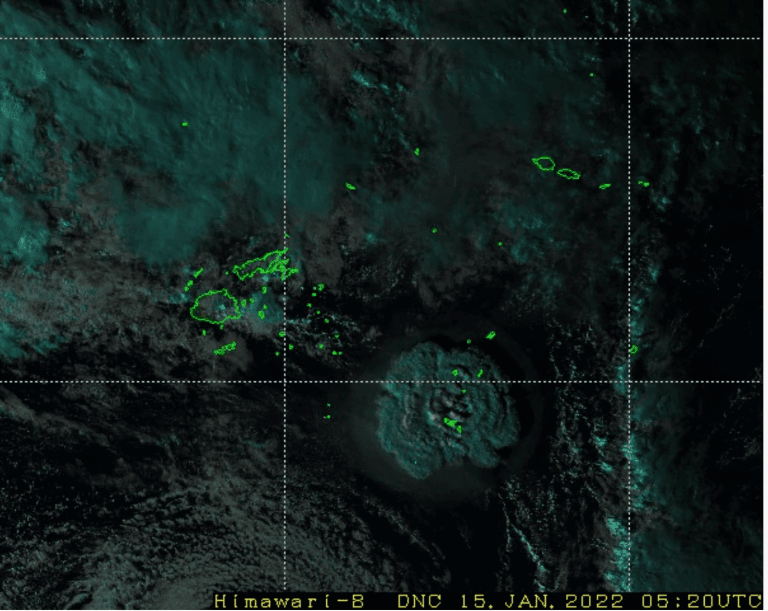
The January 2022 eruption of the Hunga Tonga–Hunga Ha'apai volcano was one of the most powerful volcanic events in recorded history. The eruption sent a pressure wave propagating outward through the atmosphere at approximately the speed of sound — a wave so powerful it circled the globe multiple times and was detectable by sensitive pressure instruments around the world.

Hunga Tonga atmospheric pressure wave — propagation diagram

Recorded from 2000 km away

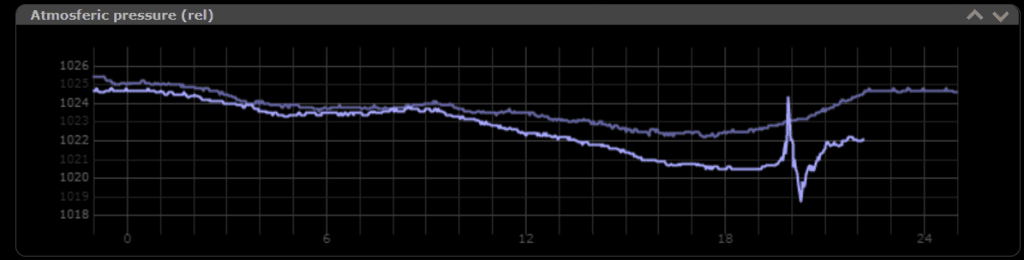
Simon Lewis, a Lunaticoastro customer in Christchurch, New Zealand, shared data from his CloudWatcher and SOLO showing the pressure signature of the eruption captured from approximately 2000 km away. The readings show a clear anomalous pressure wave that stands out distinctly from the normal atmospheric variation.

Two data visualisations document the pressure readings around the time of the eruption, clearly showing the arrival and passage of the wave.

Atmospheric pressure graph — Hunga Tonga pressure wave recorded by CloudWatcher in Christchurch

The same CloudWatcher unit in New Zealand later recorded the atmospheric pressure signature of Cyclone Gabrielle in February 2023 — demonstrating that observatory instruments can serve as incidental scientific instruments during extreme atmospheric events.

An unexpected capability

The CloudWatcher's atmospheric pressure sensor was designed to help astronomers assess night-sky conditions for observatory safety. Its ability to detect a volcanic pressure wave from 2000 km away is a demonstration of the sensor's sensitivity and the value of continuous, high-cadence atmospheric monitoring — even when the goal is simply to know whether to open the roof.