
LUNÁTICO ASTRONOMÍA POCKET CLOUD WATCHER
(«Astronomía» Magazine nº. 238 – April 2019)
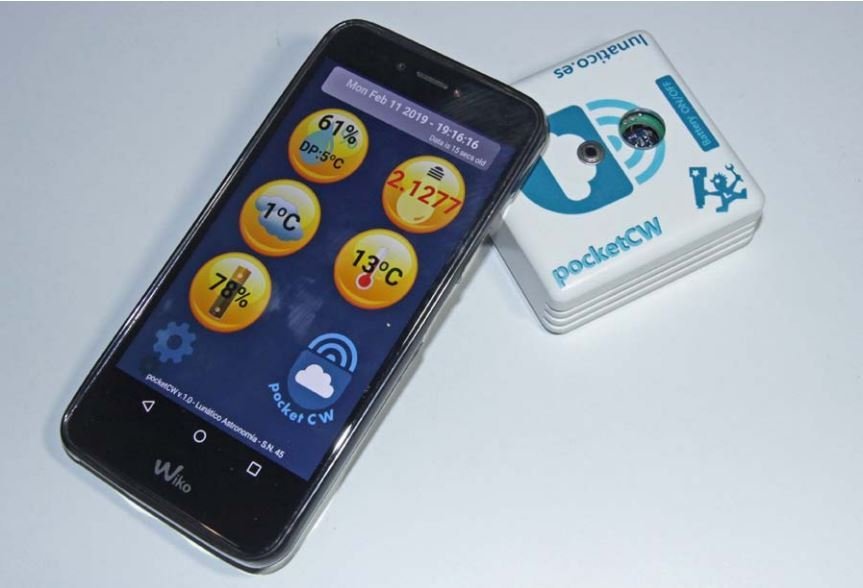
This month we bring a sort of personal weather guard. A small station that works along with a mobile application to inform us about local meteorological conditions in real-time.
Lunatic Astronomical has marketed a small meteorological station for the observatory and the astrophotographer. In a nutshell, it measures several environmental parameters and transmits the data to your phone, so any device with the Pocket CW application will be able to read it. There is also an option with mini USB to monitor them in the PC. In short, a mini meteorological station with no wires and alerts on your phone. Alerts that warn you if the sky clouds, if there is an excess of ambient light, if there is a risk of condensation, if the battery is discharging, if the temperature varies outside of the margin we have established…
Before starting
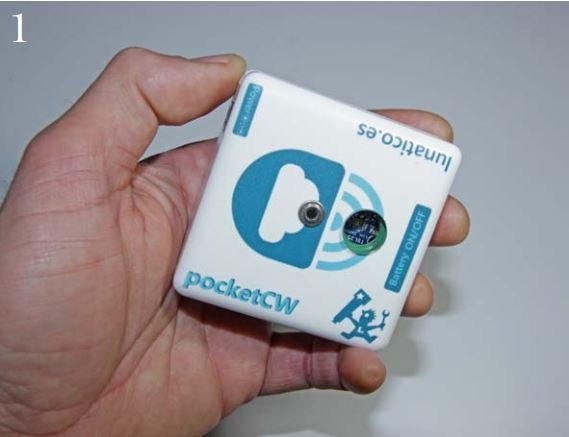
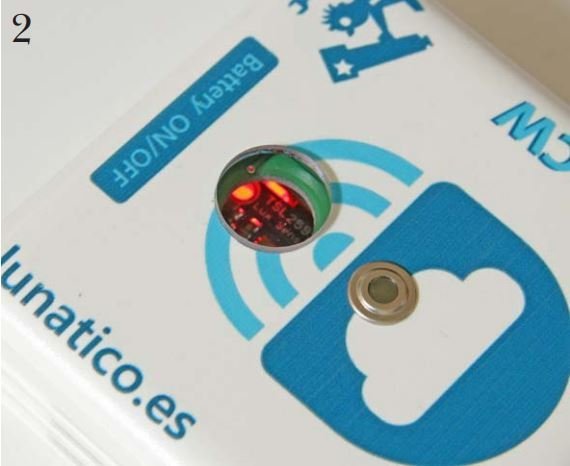
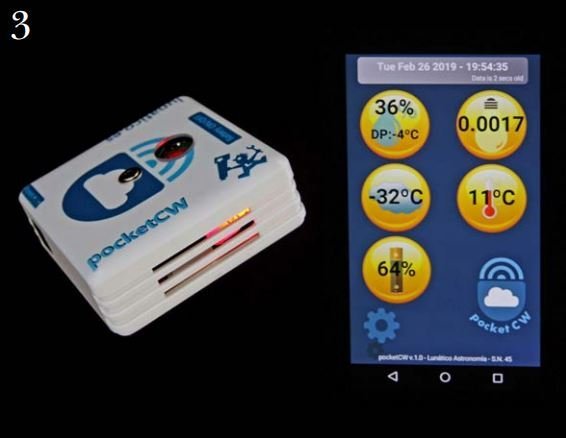
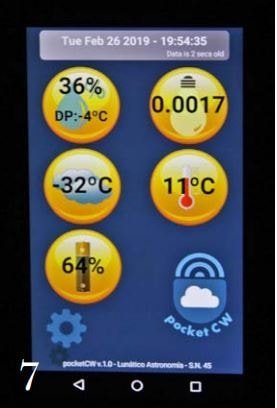
At first sight, you can see two sensors that will measure the IR and the sky brightness. Inside are the other detectors. Pocket CW measures environment temperature, sky temperature based on infrared radiation received ambient light in luxes, relative humidity, dew point, and battery charge level. I like that it measures the humidity and therefore, together with the temperature, the dew point, that is, the temperature at which humidity will begin to condense on the surfaces of the telescope. It is something that we should always be aware of since a lens, Schmidt sheet, meniscus, or mirror that is fogged is a burden.
|
Cloud detection is done by measuring the sky temperature with an IR sensor and it is the only one that requires some practice, in order to determine the appropriate temperature range. Lunático advises to set it fifteen degrees above the existing one when the sky is clear. That is to say, when the sky temperature rises fifteen degrees, it will be because of the clouds and the alarm will sound. Pocket CW is powered by 12V DC power supply via standard 5.5mm / 2.1mm jack with positive in the center. This same input is used to charge the optional battery. A battery that according to specifications lasts for almost 48 hours of continuous operation. Lastly, for communication to work properly, it is recommended not to go farther than fifteen meters away. Weather guardWhenever I have done deep sky astrophotography sessions, they have always been long. In fact, if we try to obtain the adequate signal in each shot and enough shots to satisfactorily lower the noise level, the sessions are almost always going to have to be of two to three hours of capture, or more. Although you are always a bit preoccupied when leaving the equipment working without your supervision. «Maybe the lens or the secondary mirror gets clouded, or maybe that thing that looks like a threatening band of clouds ruins my photos …”. There are environmental factors that we cannot control if we are «resting» inside the vehicle or if we simply do not have access to the telescope. The ones that I consider most important are cloudiness and dew point. Cloudiness is obvious. If it gets cloudy in the middle of the session we will return home with a bad taste in our mouths since we will not have been able to record the number of shots we wanted and we will have been in the mountain wasting time under the clouds. Well, Pocket CW has an IR sensor that detects the appearance of clouds and alerts us with an alarm on the mobile phone. The same happens with the humidity and temperature sensors that determine the dew point, also warning us with an alarm that the temperature is dangerously close to said point. The issue of cloudiness requires some learning. Pocket CW measures the temperature of the sky, in height, with an IR sensor. We know that when the sky clouds, the temperature increases, therefore, the Pocket CW will detect the cloudiness based on the temperature of the sky. Let’s suppose it measures -30 ºC. Well, a cloudy sky is a warmer sky so when it clouds, the temperature will increase. It is recommended to set the alarm at 10 or 15 ºC higher than the temperature of a clear sky for the same place. Like that, when Pocket CW measures a sky temperature of -20 ºC or -15 ºC, it will interpret that it has clouded over and the alarm will ring. These IR readings may vary from one observation site to another. By the way, high clouds do not emit heat, so Pocket CW does not detect them. 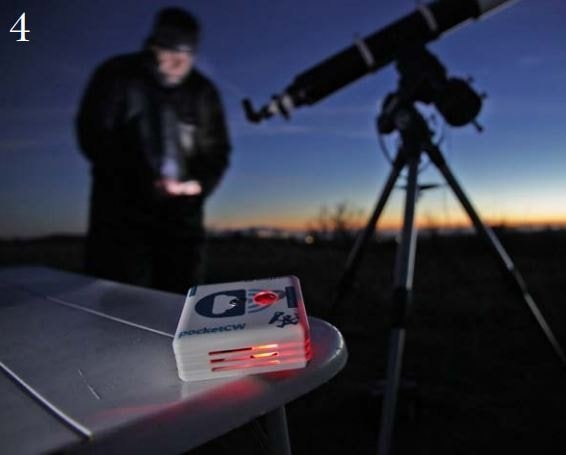 The dew point is presented in degrees of temperature. For example, if it is at 6 ºC, it means that that night, with the existing humidity level, there will be condensation if the temperature drops to 6 ºC. Astronomy lovers hate condensation. Although we may not like it, we do not care much that the tube or mount condenses moisture to the point of having to dry them a little when picking up. However, we are very annoyed if moisture condenses on the lenses or mirrors of the optical tube since if this happens we will have to stop the observation or photographic session. A foggy lens kills the contrast, scatters a lot of light, and subtracts luminosity to the point, as I said, of having to cancel observation. That is why it is so important to have a dew cap to delay condensation a little, especially in closed tubes with large openings. Refractors typically have a small aperture and long parasols and are therefore slow to fog. |
   |
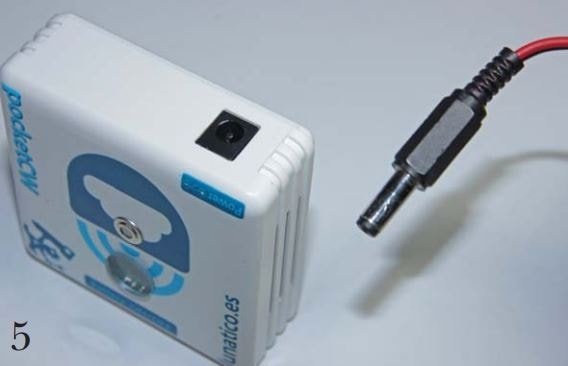 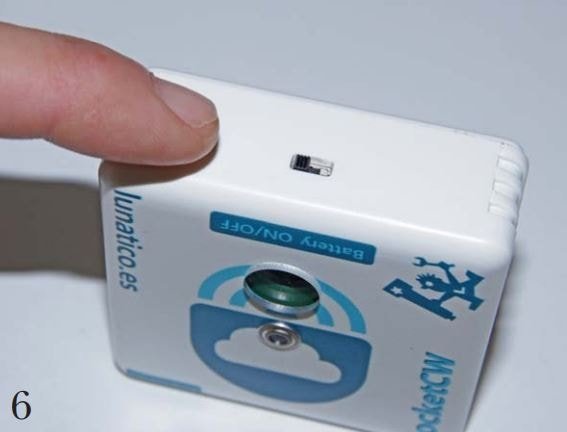  |
The secondary mirror of a Newton tube is more exposed than it seems and in very humid environments it can fog more easily than expected. Even though it is less common, it is also usual in very wet nights for the primary mirror to fog. If it is a Truss tube, worse. For nights with lower humidity, refractors are perfect while Newton tubes «condense» less than a Schmidt or Maksutov-Cassegrain. If the telescope is a closed Cassegrain with an aperture of 200mm or greater, it will tend to fog very easily. In any case, we can see that all telescopes, sooner or later, are sensitive to condensing moisture on their optical surfaces. Therefore, knowing the dew point value is essential if we want to anticipate it. COVERAGEI spent several nights with accompanied by the Pocket CW. The first thing you realize is that you have to place it at a certain height from the ground so that the signal has a decent range. On top of a table, the transmission reaches a distance of fifteen or twenty meters seamlessly, as long as there are no obstacles. Putting it on the ground is a bad idea. It barely reaches two or three meters. Something else, usually we do not sleep bivouacking in the open but we are either in a tent or in a vehicle. I don’t have a tent on hand but I do have my van. I go inside, put on a sleeping face, close doors and windows except for a small slit to breathe and check the Pocket CW’s coverage. Enough, but be careful … three meters away from the van, the mobile continues to receive data from the Pocket CW, but if you move further away you may have problems. In any case, it is not necessary that the Pocket CW is next to the telescope, it measures environmental factors so putting it next to the tent or the car is more than enough. BATTERYIt lasts a long time and loads wonderfully. All you have to do is connect the power jack of the battery that supplies the telescope to the Pocket CW and that’s it. It accepts standard power plugs, same as those used by Sky-Watcher, Orion, many Dobson GoTo mounts, etc. I had about twenty hours of total use, about three nights of testing with the battery at 99% and on the third day, there was still some charge left. The duration of the internal battery of the Pocket CW is a very positive point. ALARMSOne of the trial nights, an alarm went off. I looked and it was the one of the dew point. Great! Very useful since the temperature these days in late February was falling very fast at sunset, and at the same time, the humidity was rising rapidly. The Pocket CW alarm alerted me that it was five degrees from reaching the dew point. There are a number of different alarm sounds to choose from. You cannot put the mobile in standby mode because if we darken the screen the application stops receiving data, so keep the mobile with the battery charged or plugged in and the brightness of your screen to the minimum. OTHER NOTICESAs we said before, it also gives us a reading of the ambient temperature and the luminosity in luxes. Well, we do not usually back down due to the cold, so unless we want, for some reason, to know if it is icing over or not, it will not be the most significant data. In summary, the Pocket CW is a great «toy» to warn you of environmental problems that may ruin your astrophotography or observation session. (A) |
Translated by Ajete