
Is Starling an improved version of Dragonfly?
No. This is the most common misconception. Starling is not a newer or upgraded Dragonfly. They are fundamentally different products built around different philosophies. Starling is a specialised controller, focused 100% on opening and closing a roll-off roof safely. Dragonfly is a multi-purpose controller: the flexible brain of the observatory.
Starling: the roll-off specialist (100% roof, no distractions)
Starling's single purpose is to open and close a roll-off roof safely. Everything about its design reflects this focus. It comes pre-configured with predefined relay connections for the core roof elements—service light, alarm, and dehumidifier—plus three free relays available for additional components you may need.
Because it is a dedicated roof controller, Starling provides stable and predictable behaviour. It does not ask you to configure what each relay does: the roof logic is built in. This makes setup fast and keeps the system consistent over time, especially important in shared observatories where multiple users and programs interact with the same hardware.
What Starling controls
- Roll-off roof motor and travel limits
- Service light relay (predefined)
- Alarm relay (predefined)
- Dehumidifier relay (predefined)
- Three additional free relays for custom elements
Starling is not designed for domes. It targets roll-off roofs exclusively. If your observatory uses a dome, Dragonfly is the right controller.
Dragonfly: total freedom to control the observatory your way
Dragonfly is a multi-purpose observatory controller. All of its relay connections are user-defined, which means you decide what each one does. This flexibility lets Dragonfly manage virtually any combination of observatory equipment, from motors and mounts to focusers, cameras, weather sensors, and dew heaters.
What Dragonfly can control
- Motors and telescope mounts
- Astronomy cameras
- Focuser systems (Seletek and others)
- Limit sensors and webcams
- Dew heater bands (ZeroDew)
- Flat panels and all-sky cameras
- Hydreon rain sensors and anemometers
- CloudWatcher integration
- Roll-off roofs (as one of many tasks)
Dragonfly also supports advanced features that Starling does not: macros, safety restrictions, and operating conditions, tools that let you automate complex sequences and protect your equipment across varied scenarios.
'Install and go' vs 'configure it your way'
The clearest way to understand the two products is through their setup philosophy. Starling is designed to be installed and used immediately: the roof logic is predefined, the safety behaviours are built in, and there is little to configure. Dragonfly requires more initial configuration precisely because it can do more: you define what each relay and input connects to, and you build the behaviour you want through its interface.
Neither approach is better in the abstract. If your observatory is a roll-off with a straightforward roof that multiple users share, Starling's simplicity is a genuine advantage. If you need to orchestrate a wide range of internal equipment and want programmatic control over how everything interacts, Dragonfly's flexibility is exactly what you need.
Multi-user: system behaviour
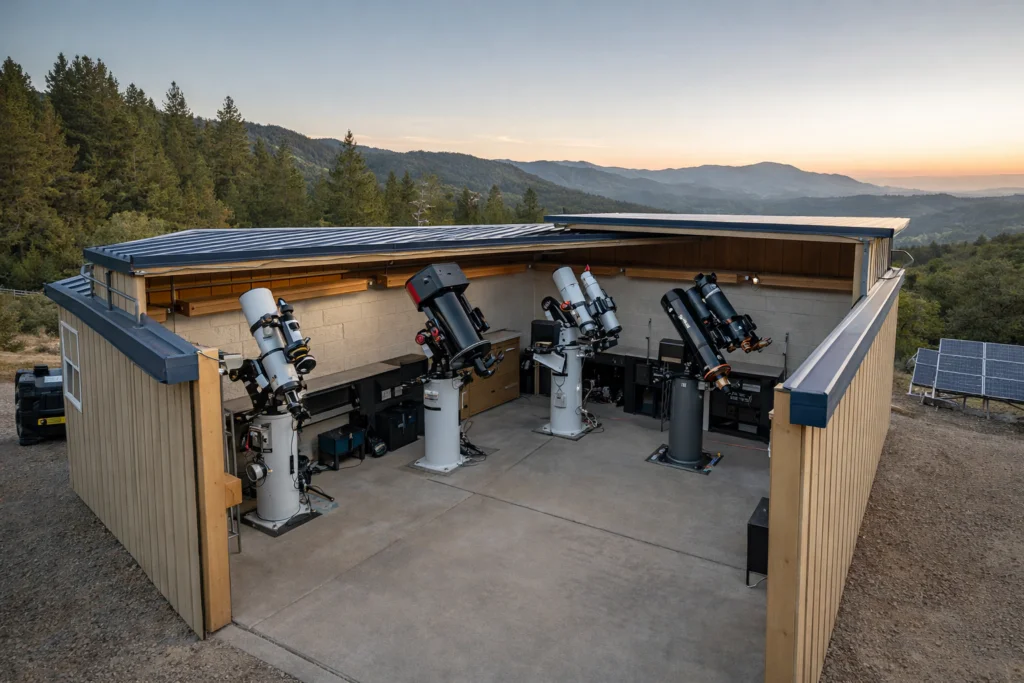
This is one of the most important practical differences between the two controllers.
Starling is specifically designed for shared, multi-user observatories. When multiple users or astronomy programs are running simultaneously, Starling reports open and close requests independently of the actual roof state for other users. This means each user's software behaves consistently: the system appears to respond to each program's commands as expected, without one user's state affecting another's experience.
Dragonfly, by contrast, operates under a single-user control model. Its strength is full customisation for one operator or one automated session at a time. It is not primarily designed for concurrent multi-user environments.
Can Starling and Dragonfly be used together?
Yes, and this is a very common and recommended setup. Starling and Dragonfly can work together in the same observatory, each handling the tasks it was designed for. A typical combined configuration looks like this:
- Starling—dedicated to the roll-off roof: opening, closing, safety logic, multi-user coordination
- Dragonfly—dedicated to the internal elements: mount, focuser, cameras, dew heaters, sensors, macros
This pairing gives you the best of both worlds: the reliability and multi-user behaviour of a dedicated roof controller, combined with the full observatory automation power of Dragonfly.
And in a dome?
Dragonfly works well in dome observatories for controlling internal equipment. Starling is not designed for domes. It targets roll-off roofs exclusively. If you have a dome and need a controller for the internal elements, Dragonfly is the appropriate choice.
Quick comparison table
| Feature | Starling | Dragonfly |
|---|---|---|
| Main focus | Dedicated roll-off roof control | General observatory control |
| Wiring flexibility | Predefined connections (3 free relays) | Fully user-defined connections |
| Internal equipment control | No (3 free relays only) | Yes |
| Roll-off roof control | Yes (main purpose) | Yes |
| Roof safety logic | Yes, roof-specific | Yes, single-user focus |
| Multi-user / multiple programs | Designed for shared observatories | Not primary focus |
| Macros and restrictions | No | Yes |
| Dome use | No | Yes |
To make it clear
Is Starling an improved Dragonfly?
No. Starling focuses exclusively on roll-off roofs and multi-user behaviour. Dragonfly is a flexible multi-purpose controller. They solve different problems.
Does Dragonfly make sense for roof-only control?
Dragonfly can operate a roll-off roof, but its real strength is broader observatory control. If the roof is your only need, Starling is the simpler and more appropriate choice.