
Slow PWM output

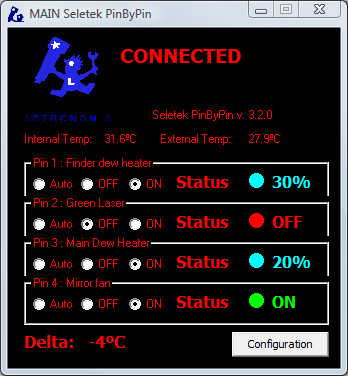
Seletek PinByPin — slow PWM mode configuration screen
PinByPin slow PWM mode — select a pin, set the period and duty cycle, and enable the PWM output for variable power control.

Slow PWM runs at a frequency much lower than the motor PWM — typically 1–10 Hz — which makes it suitable for resistive heating elements and other thermal loads. At these frequencies, the PWM cycles are long enough that the load's thermal inertia averages the power naturally, without any additional filtering.

The duty cycle is expressed as a percentage. At 50%, the output is on for half the period and off for half, delivering 50% of maximum power to the load. At 100%, the output is always on.

Applications

  • Dew heater strips: Connect a dew heater element to the Seletek's switched output and use slow PWM to regulate the heat level without a separate dew controller. Combine with temperature sensor input to automate power based on dew point margin.
  • Peltier cooling: A Peltier cell driven through a MOSFET can be power-modulated with slow PWM. This is useful for sensors that need slight cooling without the full power consumption of running the Peltier at 100%.
  • Indicator LEDs: A slow blink rate on an LED (e.g., 0.5 Hz, 50% duty cycle) gives a clear visual heartbeat signal that the Seletek is powered and running — visible at a glance across the observatory.

Using slow PWM in PinByPin

  1. Launch PinByPin and connect to the Seletek.
  2. Select the output pin you want to control from the pin list.
  3. Switch the pin's mode from Digital Out to Slow PWM.
  4. Set the Period (in seconds) and the Duty Cycle (0–100%).
  5. Click Apply — the output starts cycling immediately.

The PWM continues running as long as the PinByPin application is connected. If you disconnect, the output goes to the off state.

Current limits: The Seletek's output pins have a maximum current rating. For loads over 500 mA, use an external MOSFET or relay driven by the Seletek pin, rather than connecting the load directly. Exceeding the pin's current limit will damage the output stage.