Optical detection, not mechanical

Traditional rain gauges use a tipping bucket mechanism, a small cup that fills with water and tips when full, counting each tip as a measured increment of rainfall. For observatory automation, this approach has a fundamental problem: the sensor only registers rain after a measurable quantity has already fallen. By then, your optics may already be wet.

The CloudWatcher uses a Hydreon RG-9 optical rain sensor, which detects individual raindrops as they land on the sensor lens, without any mechanical components.

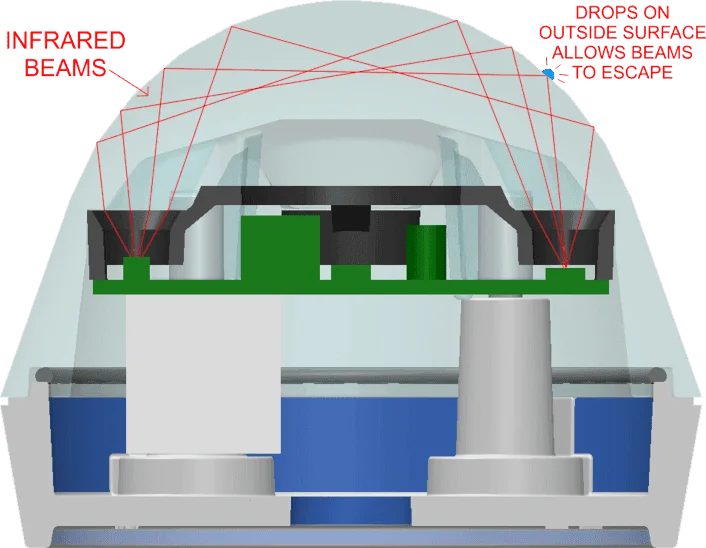
Cross-section diagram of the Hydreon RG-9 rain sensor showing internal optics
RG-9 cross-section—infrared beams are contained within the lens dome; a raindrop on the surface breaks the beam and is detected immediately

How it detects rain

The sensor generates infrared light directed through a shaped lens. In dry conditions, the beams undergo total internal reflection and stay within the lens. When a raindrop lands on the outer surface, it changes the optical properties of the lens boundary: some infrared light escapes, and the sensor detects the corresponding drop in beam intensity.

The digital signal processing inside the sensor identifies the size of the raindrop that caused the change: it can detect drops smaller than half a millimetre in diameter. Each drop registers immediately as it lands, rather than waiting for a threshold accumulation.

<0.5 mm Minimum drop diameter detected
100× More sensitive than tipping-bucket gauges—registers accumulations as small as one ten-thousandth of an inch
0 Moving parts

Why it doesn't false-trigger

Three design features prevent false detections:

  • Total internal reflection by design—the patented optic geometry keeps infrared beams inside the lens under normal conditions, so falling leaves, spiderwebs and insects on the lens surface do not trigger rain events the way they might with simpler sensors.
  • Environmental compensation—the sensor continuously monitors the baseline state of the lens surface, including accumulated dirt, contamination and gradual lens aging. It adjusts its detection threshold automatically, so a dirty lens doesn't permanently degrade sensitivity.
  • Ambient light rejection—sophisticated digital signal processing filters out interference from sunlight and artificial lighting, which is where the automotive heritage of the technology proves its worth.

The Hydreon sensor was originally developed for automotive rain-sensing windshield wiper systems, an application where false triggers are costly and misses are immediately obvious. That design requirement produces a sensor well-suited to unattended observatory operation.

What it doesn't replace

The rain sensor detects precipitation landing on its lens. It does not measure rainfall rate or accumulation in any absolute unit. For observatory safety purposes, what matters is detecting the onset of rain at the sensor location, which is exactly what this sensor is optimised for.

The CloudWatcher combines rain sensor data with the infrared cloud sensor, wind speed, humidity and temperature readings to make SAFE/UNSAFE decisions. Rain is one input among several; a safety system that relies on a single sensor is inherently less robust than one that monitors multiple independent channels.