Español English
Lanternfish
A sky darkness meter
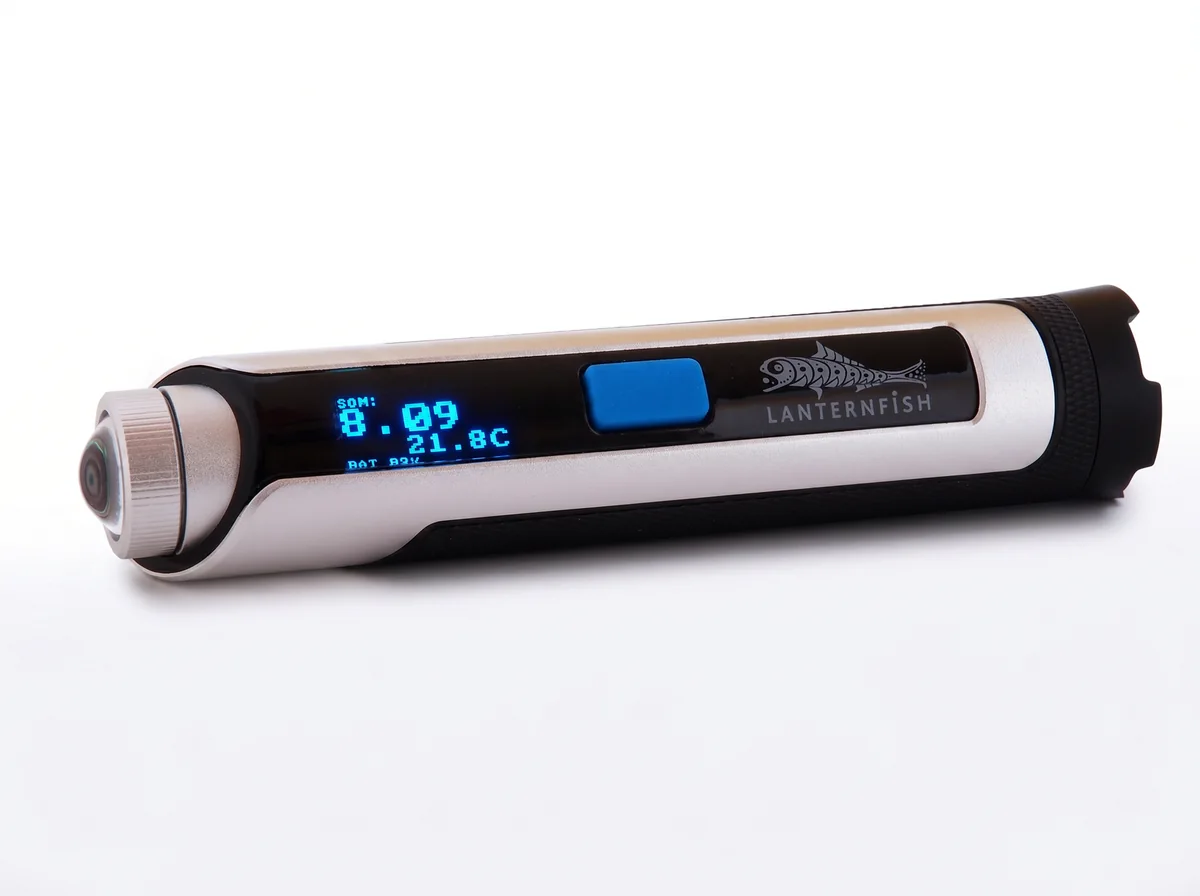
In two seconds you get an accurate measurement of how dark the sky is, right there on the screen.
164.46 € + VAT, which depends on your country
It's the light that, instead of lighting the ground, escapes upwards, due to badly aimed street lamps, floodlights on warehouses and industrial estates, shop windows left on all night, the lighting of a football pitch... That light bounces off the air and the sky, rather than staying black, turns an orange-tinted grey.
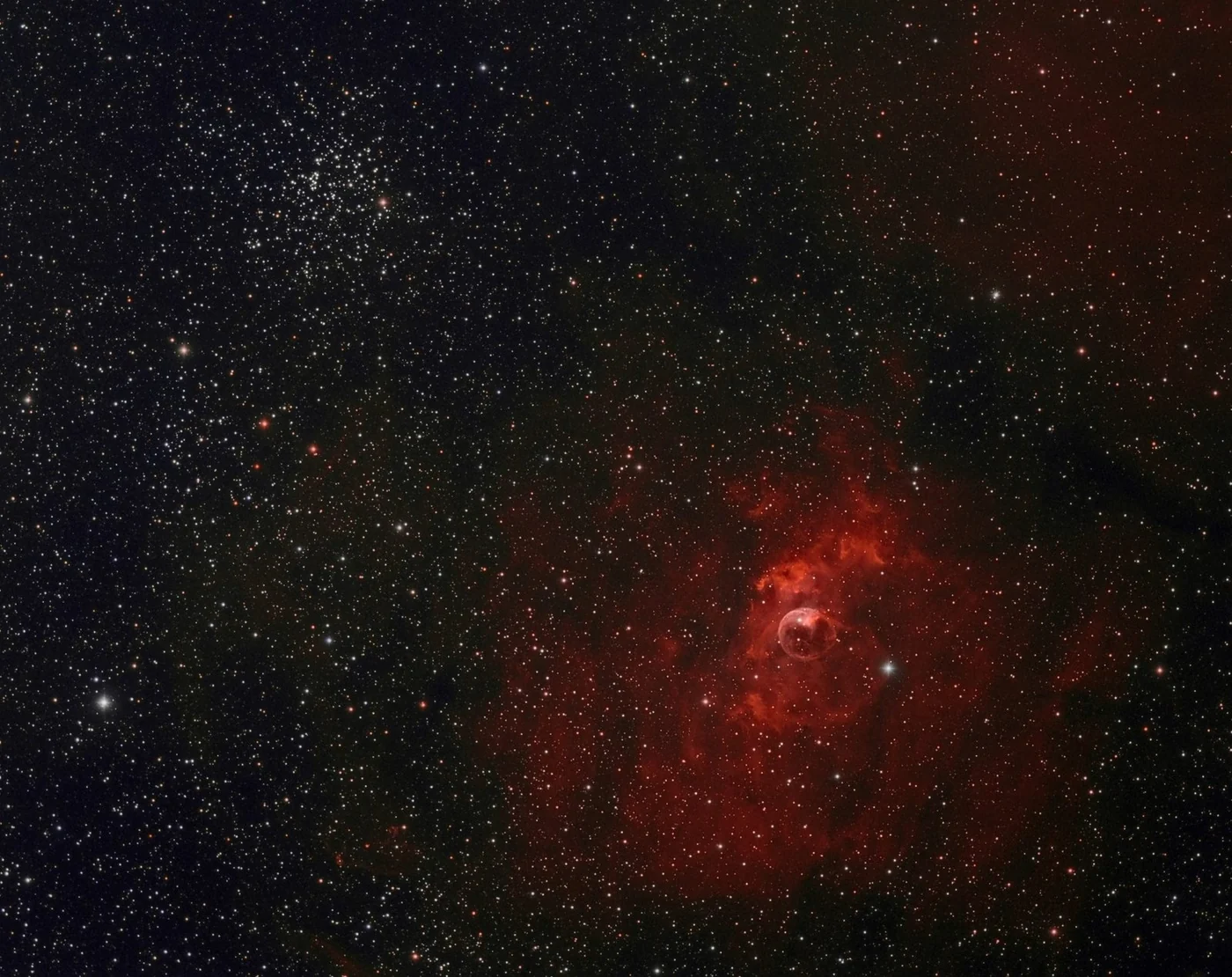
The stars are still there, but they stop being visible. In the centre of a city you can count a few dozen stars with the naked eye; whereas without the lights you would be able to make out thousands.
And it is not only a shame when it comes to star-gazing, it also affects the ecosystem. Insects wear themselves out circling a street lamp until they drop, many birds migrate at night using the sky to find their way, and the light sends them off course, and that's just to name a couple of examples. Light pollution affects us too, disrupting our circadian rythm (which is essential for sleep regulation, hormone production, and overall health).
The good part is that, unlike almost any other kind of pollution, this one is easy to fix: turn the lights off. It leaves no residue and there is nothing to clean up.
The night a light goes off, the sky gets better.
Much as a thermometer tells you the temperature, the Lanternfish measures darkness accurately.
You point it at the sky, press the button, and a value appears on the screen. That's all. The higher it is, the better the sky.
To give you an idea: in the centre of a city that number is around 17 or 18. In a small village, close to 20. And in the places amateurs call dark skies, it goes above 21 (22 being the practical maximum). The difference between 18 and 21 is the difference between seeing the Moon and four stars, or seeing the Milky Way crossing the sky from side to side.
The screen shows the word MPSAS: that is the technical name for this measurement, magnitudes per square arcsecond. You don't need to know exactly what it means, but essentially, it tells you the amount of light (in magnitudes, the same measure used for the brightness of stars) per unit of sky "surface"—instead of metres2, since the sky is a sphere, it is measured in degrees2, or in this case arcseconds2: a square with one arcsecond on each side. As an example, the surface of the Moon seen from the Earth is about 2.5 million arcseconds2.
You will know whether tonight is worth getting the binoculars out, whether the place you're going camping has a better sky than your terrace, and how much it gets worse when they turn on the lights at the sports centre next door.
For anyone who enjoys the sky and already has a telescope, or binoculars, or just looks up with the naked eye.
Biologists, nature reserves, town councils, schools, citizen science projects, or rural guesthouses that need to know how the sky is at a given place and how it changes over the years.
You do not need to be an astronomer.
It arrives in its box, you switch it on and it works: no complications.
164.46 € + VAT. If the person you are giving it to looks at the sky, they will know exactly what they are holding.
Buy
The Lanternfish can record measurements night after night, storing the data in its memory, ready to download and inspect at any time, and is fully configurable.
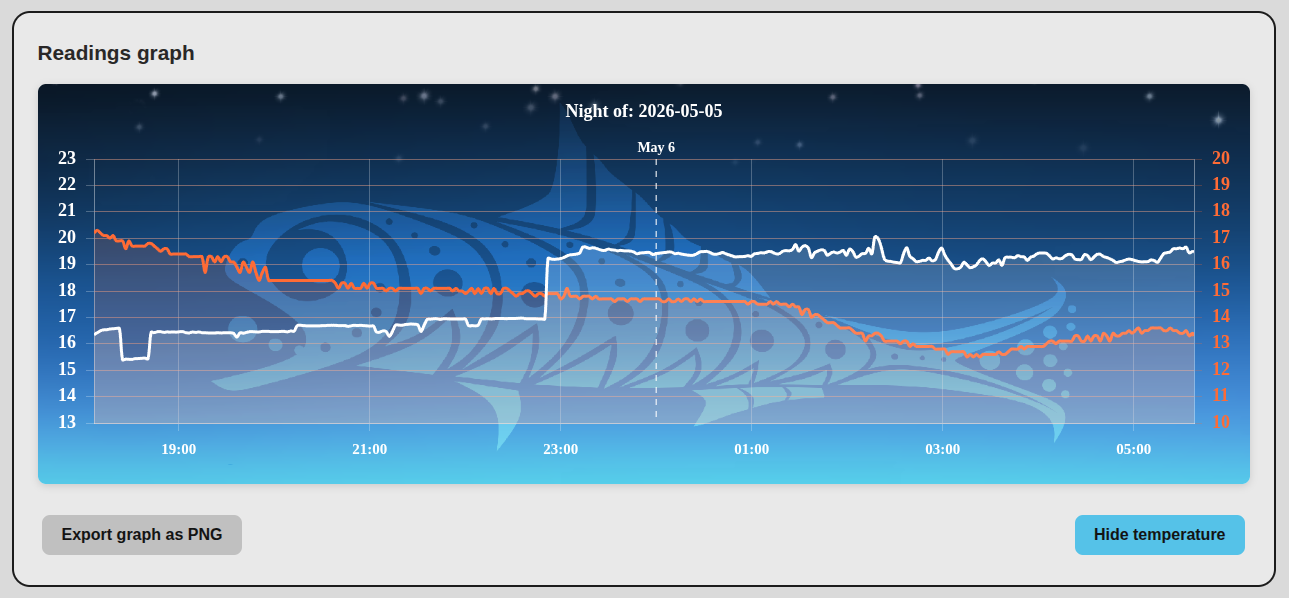
How much darkness a habitat has lost can stop being an impression and become a number you can quantify. With the Lanternfish you can compare the inside of a park with its edge, or keep track year after year of whether the glow from the town next door is growing.
Before and after changing the street lamps. Whether a switch to LED has reduced the glow going upwards or made it worse, the Lanternfish lets you see the real figures. And it works just as well to check that a new installation meets what the local regulations say.
"You can see so many stars here" is something everybody says. Why not have a measurement of your own, with its date and its graph? The Lanternfish lets you show the real readings on the guesthouse website, and you can repeat the measurement in front of the guest.
As the Lanternfish data can be downloaded in CSV, a group of students can map the light pollution of their town, compare the school playground with the outskirts, or see how much the sky changes with the weather.
No. If you can use a thermometer, you can use this. You switch it on, point it upwards and read the number on the screen.
It has one button and a screen, and that is all it takes to make a measurement. For everything else—looking at the history, drawing the graph for the night or downloading the data—you connect your phone or laptop to its Wi-Fi and open the browser. There is no software to install.
Yes. It records all night long with nobody attending it, exports the data as CSV and can be checked on remotely over your existing Wi-Fi network. It is the same device: there is no amateur version and a professional one.
It depends on the mode: in periodic mode, several nights. In remote mode, with Wi-Fi on all the time, several hours. It recharges over USB-C, and for continuous operation with Wi-Fi it can simply be left plugged in (if power goes out and the battery dies, it'll turn on by itself once it's back).
As supplied, it does not withstand rain or excessive humidity that condenses. It can be placed in an observatory that closes in those conditions. If you need a permanent outdoor installation, get in touch with us and we will talk it through.
On the full Lanternfish product page, with all the details of the measurement, the operating modes and the interface.