LUNATICOASTRO.COM

Remote Observatory Solutions and More

LUNATICOASTRO BY LUNATICO ASTRONOMIA S.L. AND LUNATICOASTRO PACIFIC LTD.

Generic selectors
Exact matches only
Search in title
Search in content
Post Type Selectors

STARLING SHARED OBSERVATORY CONTROLLER

Lunaticoastro’s device to remotely control shared observatories

Find here all the Lunatico products information

Latest Starling news!

—January 2026: the STARling comes out in the market!


Curious about news relating to other products? Check out our latest product news page. You can also join our product news newsletter from there!

Starling is designed as a near plug-and-play roof control solution for professional and semi-professional shared observatories

It consolidates roof control, safety monitoring and automation into a single controller, simplifying deployment and operation in multi-user environments.

Sentinel and Client Roles

Sentinel (Observatory Manager)

Observatory manager with full control over the infrastructure and safety conditions. The Sentinel supervises the system and can take over control when required.

Clients (Observatory Users)

Authorised observatory users who interact with the system under a common access model, enabling coordinated and conflict-free operation in shared observatories.

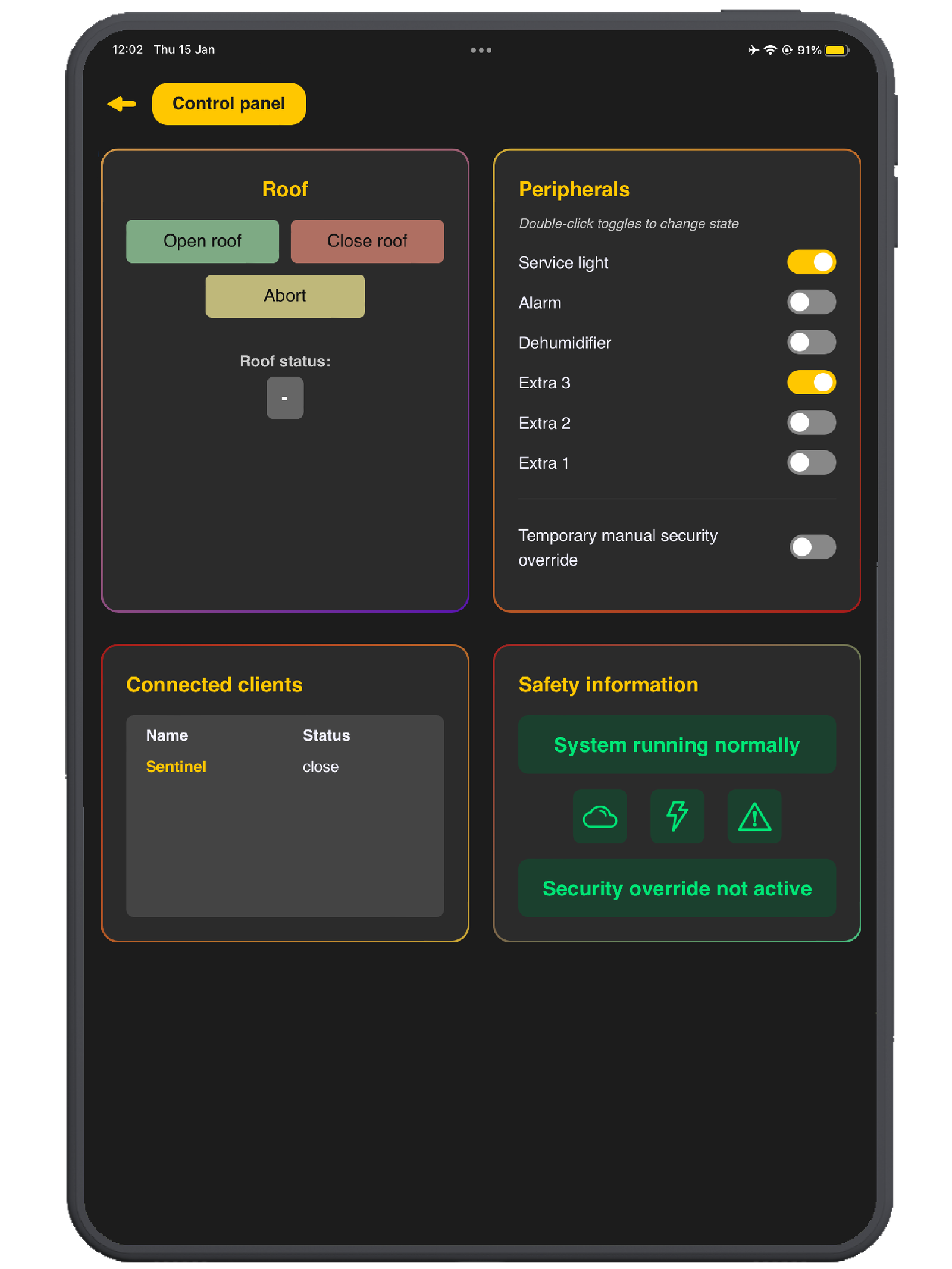
Access permissions depend on the user role, not on the device used: Sentinel and Clients can access Starling from desktop, tablet or mobile devices.

Supported Roof Systems

  • Automated roofs using Caterpillar SSR

    Fully integrated support for automated roofs using Lunatico’s Caterpillar SSR controller, providing seamless and reliable roof operation within shared observatory environments.

  • Automated roofs using third-party motorisation

    Compatibility with roofs automated using third-party motorisation systems, such as garage door motors, allowing Starling to be integrated into existing observatory installations.

  • Roofs driven by three-phase motors with VFD

    Support for roofs powered by three-phase motors controlled via a Variable Frequency Drive (VFD), enabling Starling to manage industrial-grade roof systems safely and efficiently.

  • Roof flaps (auxiliary side hatch/panel) driven by linear actuators

    Starling can control roof flaps (auxiliary side hatch/panel) as long as they are moved by linear actuators, enabling automated sequences alongside roof operation.

All roof control functions are consolidated in Starling: motion control, safety inputs, and automated operation sequences.

Starling, to remotely coordinate control of shared observatories.

Easy to use and with powerful features.

Highlights of the Starling Shared Observatory Controller

  • Designed to enable several clients (users) to seamlessly interact with a shared observatory
  • Includes safeguards for the owner of the roof (the sentinel) to be able to take over where necessary
  • Powerful and versatile controller for observatory equipment: roof, alarm, lights, dehumidifier, and much more!
  • With functionalities to allow clients to interact with the roof as if they were the only ones sending commands to it
  • Ensures ASCOM compliance so clients can continue to use their preferred astronomy software
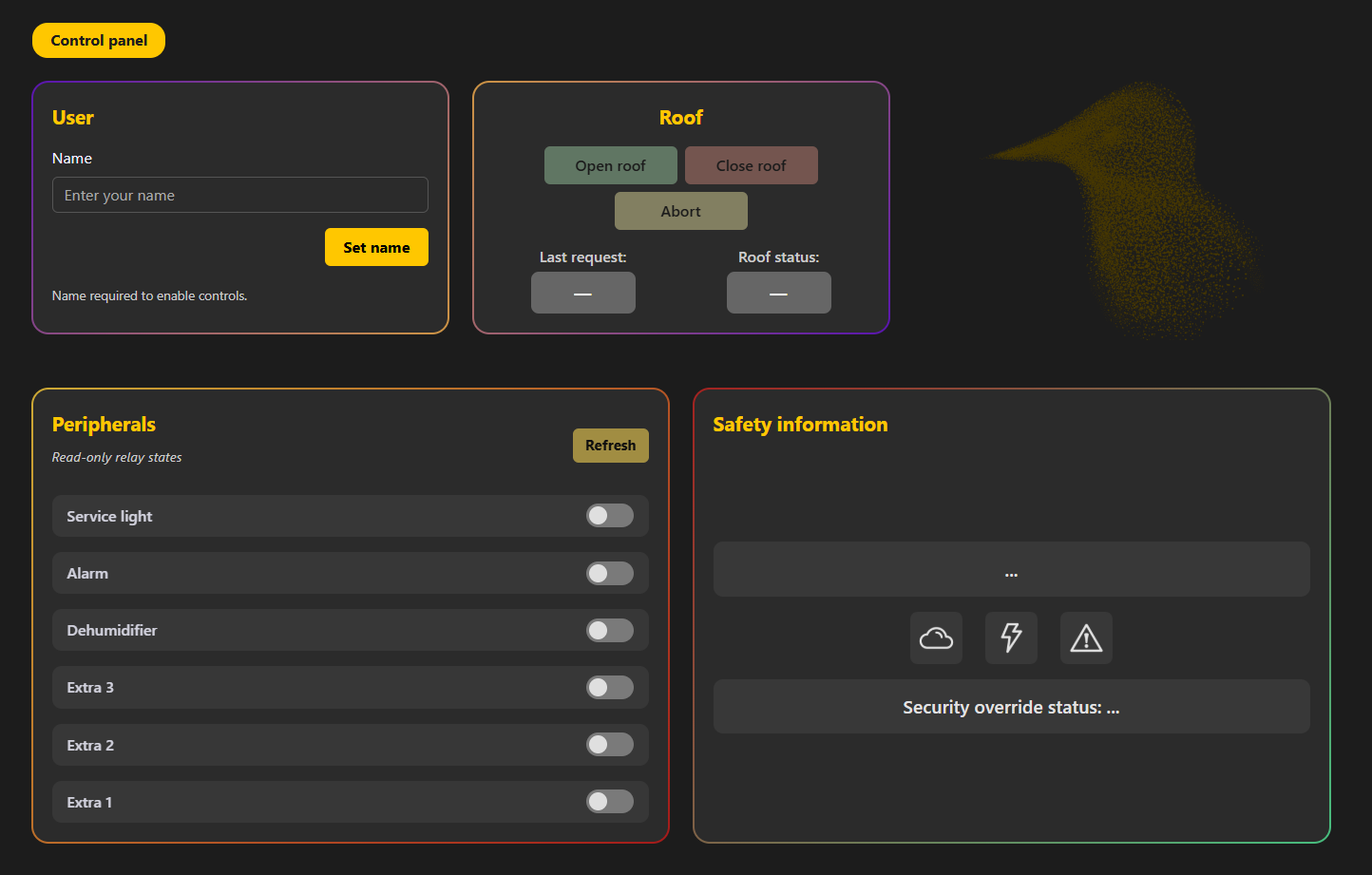
  • With different access levels: comprehensive control panel for the sentinel and public control panel for clients
  • Local manual control (no PC required). Starling allows physical buttons or switches to be connected for manual operation — ideal for maintenance tasks or quick on-site control without powering up a computer.

Accessible for clients via

All the Lunatico devices with ASCOM safety monitor and observing conditions drivers available
ASCOM driver
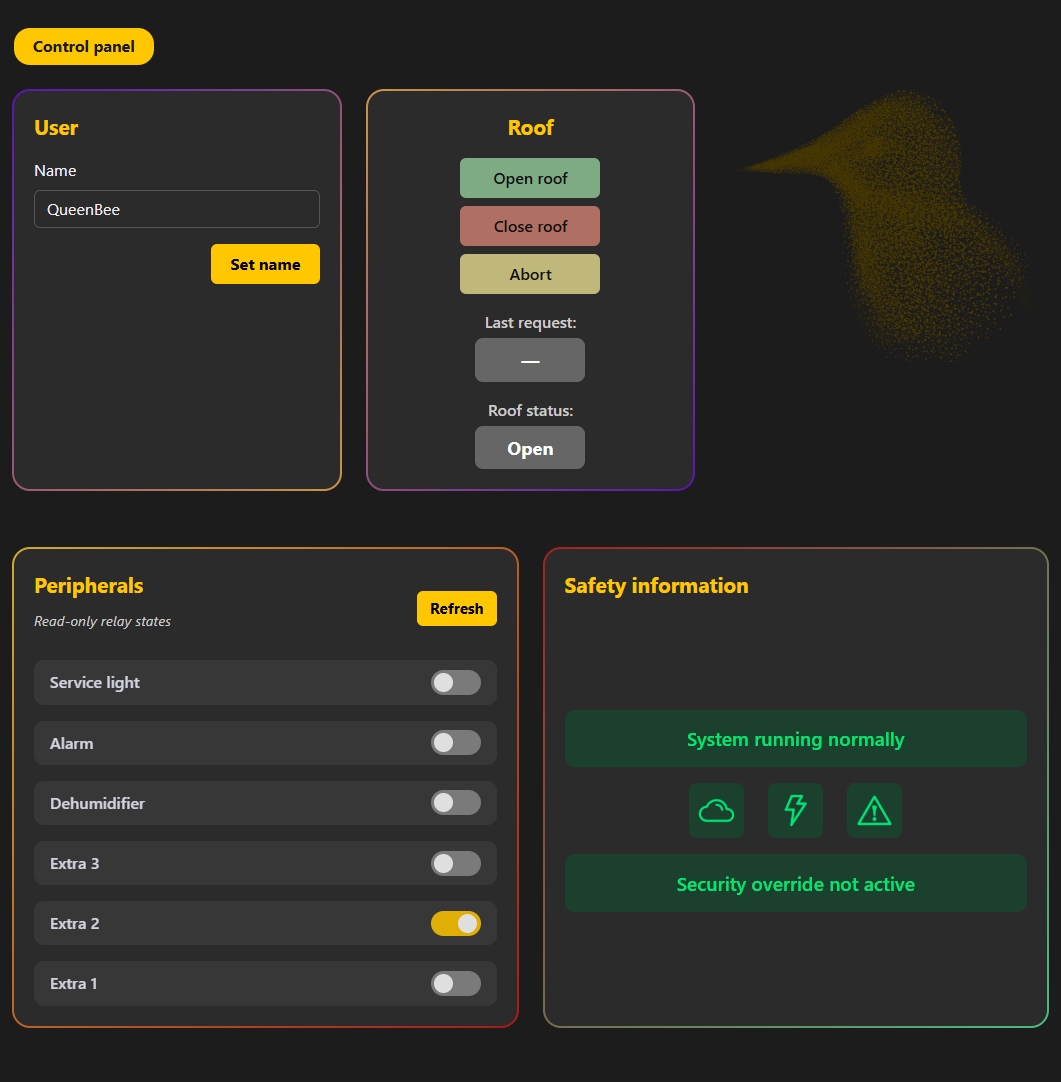
Desktop interface for shared observatory control
Public control panel
REST API / Web integration
All the Lunatico devices with free INDILib software available.
INDILib support coming soon

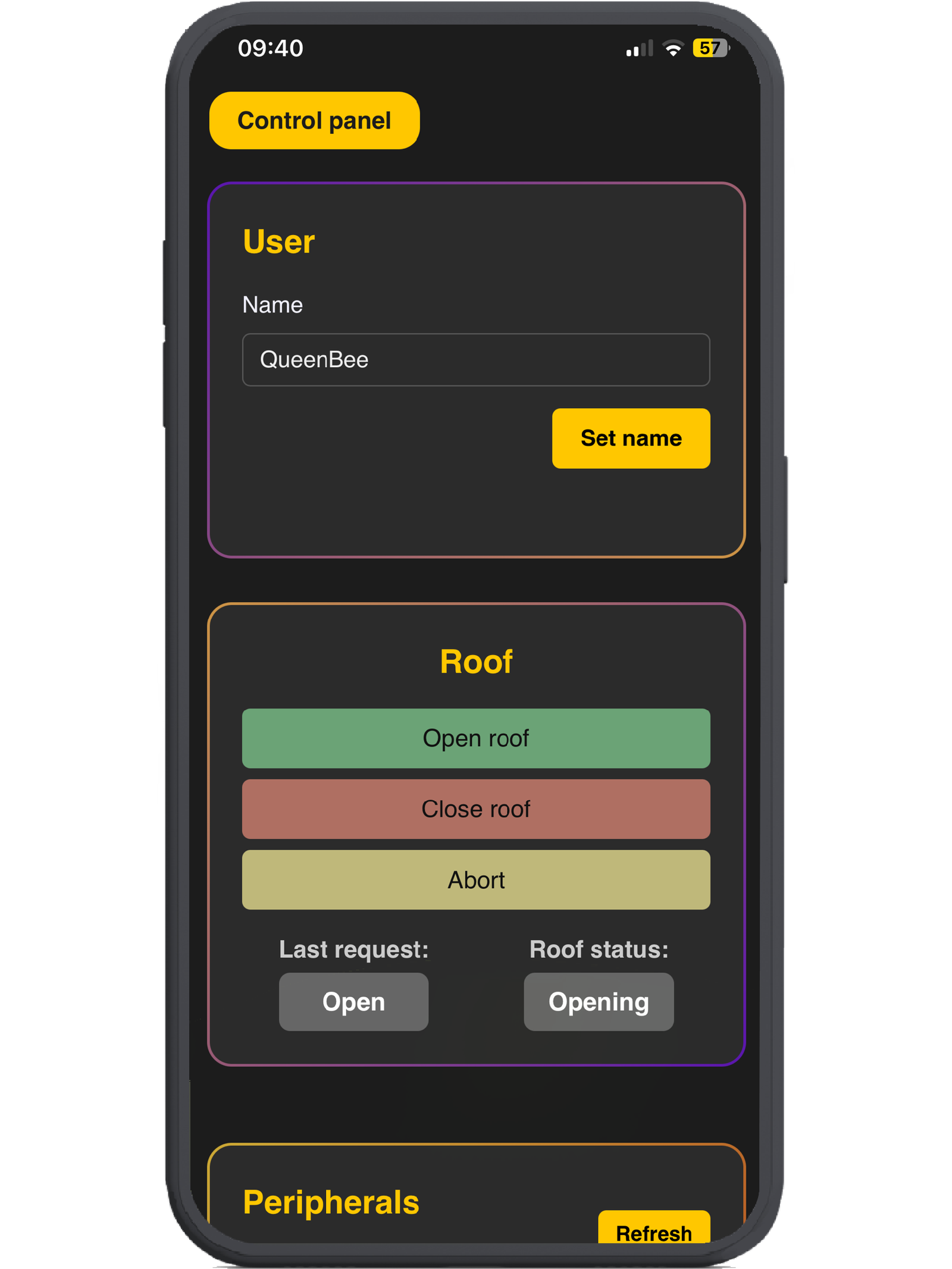
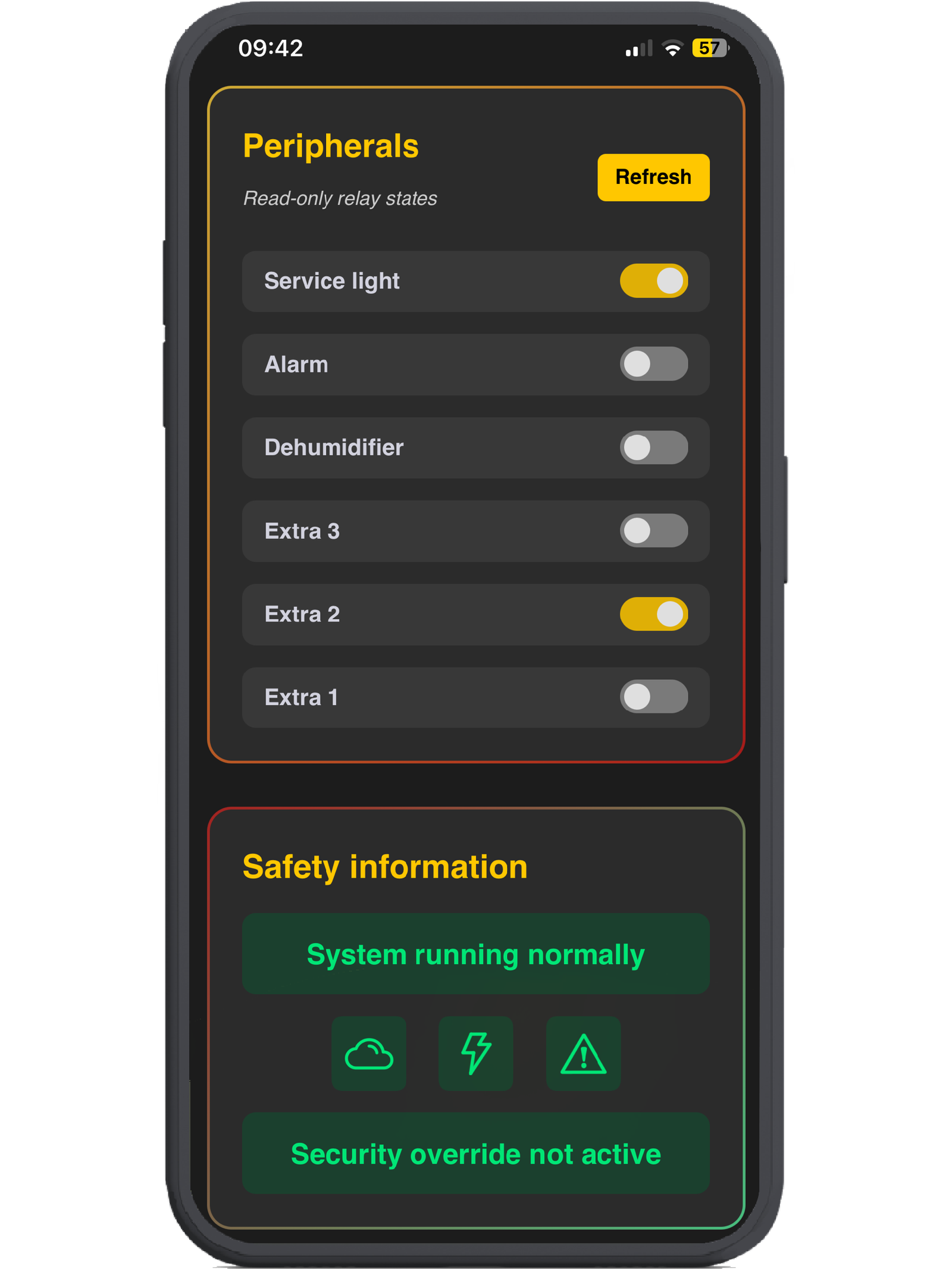
Mobile-friendly control panel.

No app needed!

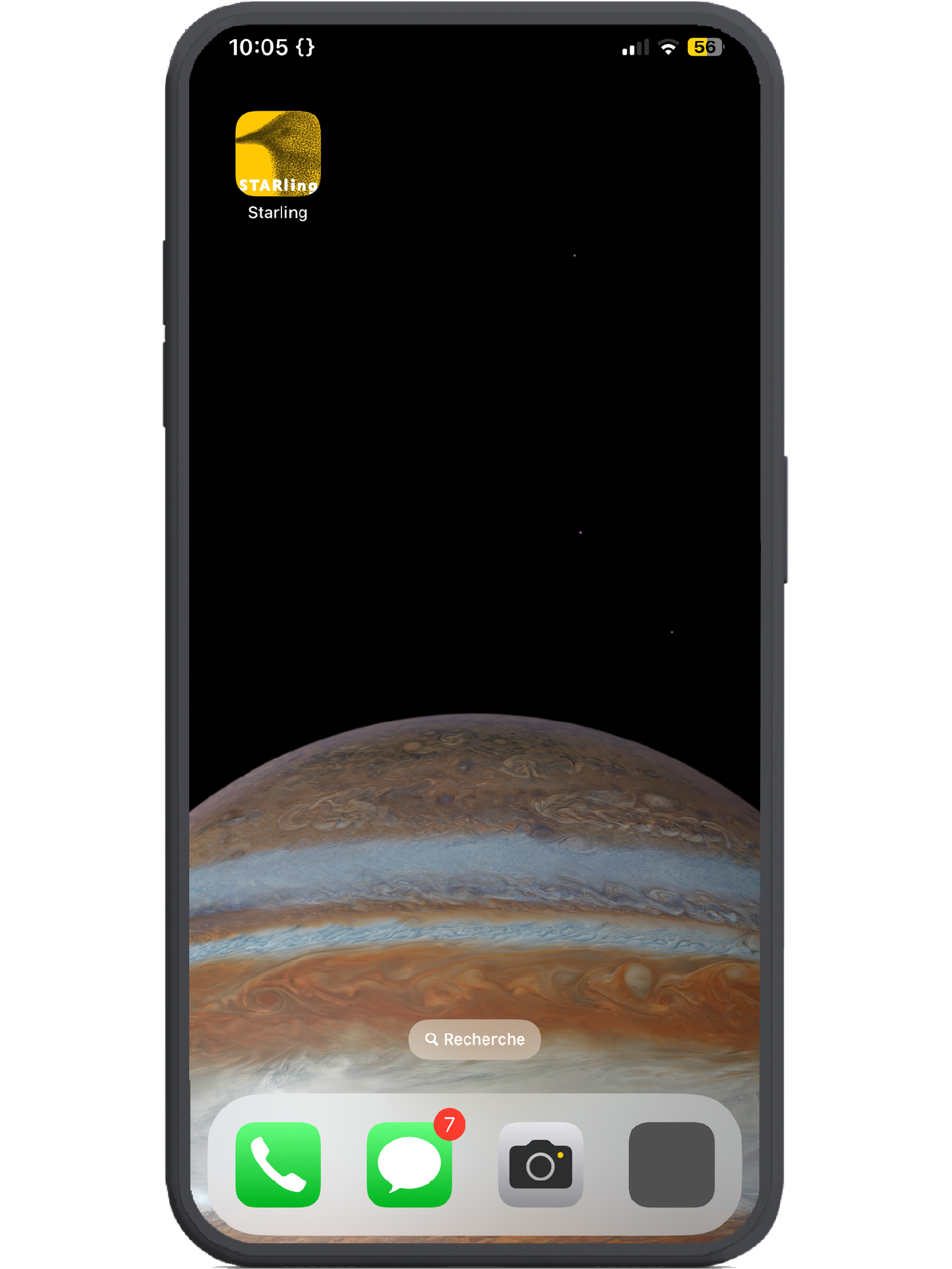
Pinning the Starling’s Control Panel to the home screen gives it an app-like feel!

Starling control panel pinned to phone homepage
Starling interface accessed from a smartphone

With the Starling

The sentinel can:

  • open and close the roof
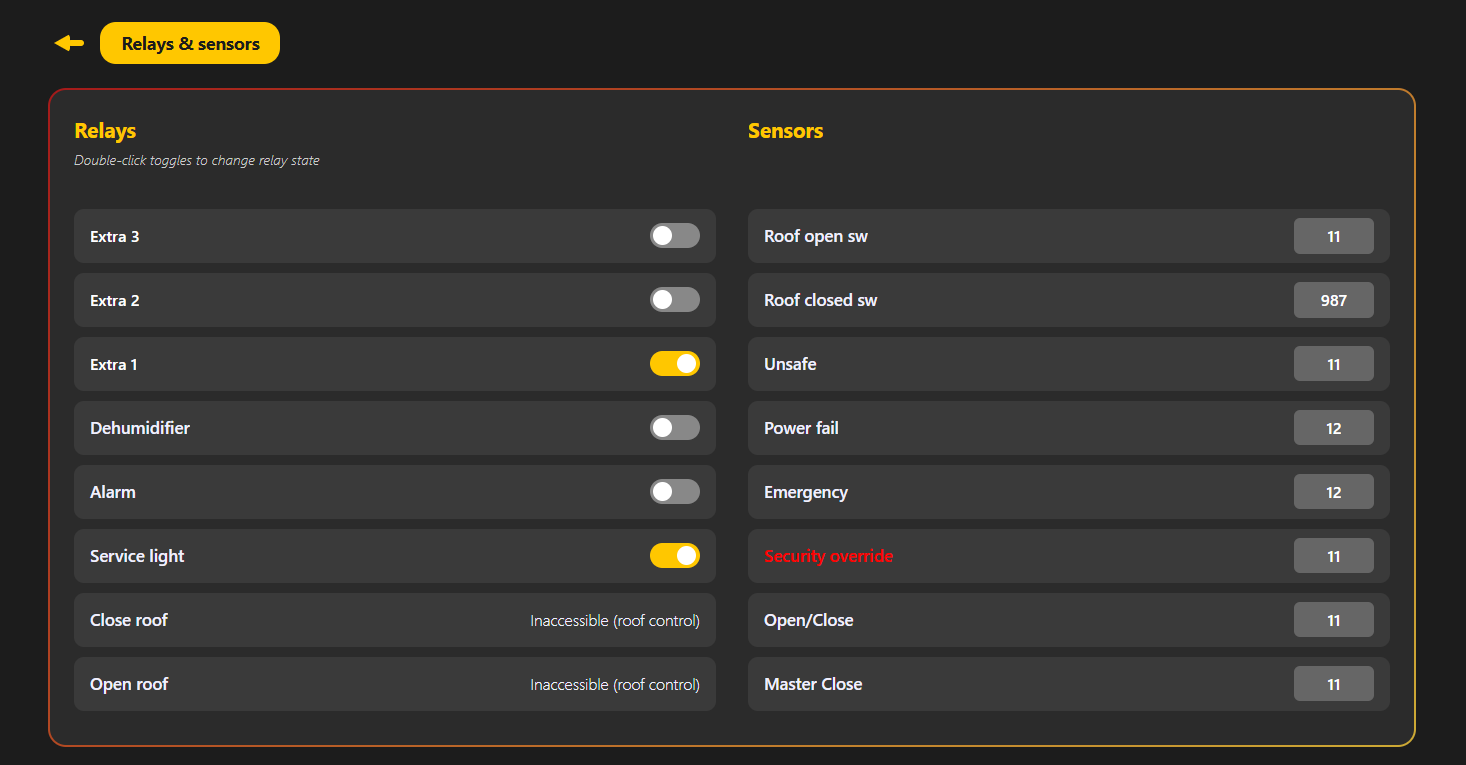
  • can control any device connected. In addition to the fixed outputs for service light, alarm and dehumidifier, Starling provides 3 free relay.
  • view and monitor requests from clients
  • monitor safety conditions with the Cloudwatcher or other safety devices
  • override safety conditions and operate manually (open/close the roof or trigger outputs when required)
  • monitor a number of other conditions through sensors, including the status of the roof, power fail, emergency…


Clients can:

  • open and close the observatory roof
  • monitor the roof position in a “single-user” way, ensuring third-party automation software behaves correctly
  • interact with the roof via third party software (Sequence Generator Pro (SGP), Voyager, ACP Observatory Control Software, N.I.N.A. and more) through ASCOM, or via the public control panel or via API
  • check the status of devices connected to Starling
  • monitor observatory conditions including safety status

A simple API enables easy integration with existing applications and custom web dashboards (for example, an observatory status page), while offering the versatility, robustness and reliability required for professional and semi-professional installations.

Local manual control (no PC required)

Starling supports local manual control using physical buttons or switches, enabling essential actions without a PC.

This is especially useful during maintenance, allowing an operator to open/close the roof, turn the service light on/off, or activate configured outputs directly on site.

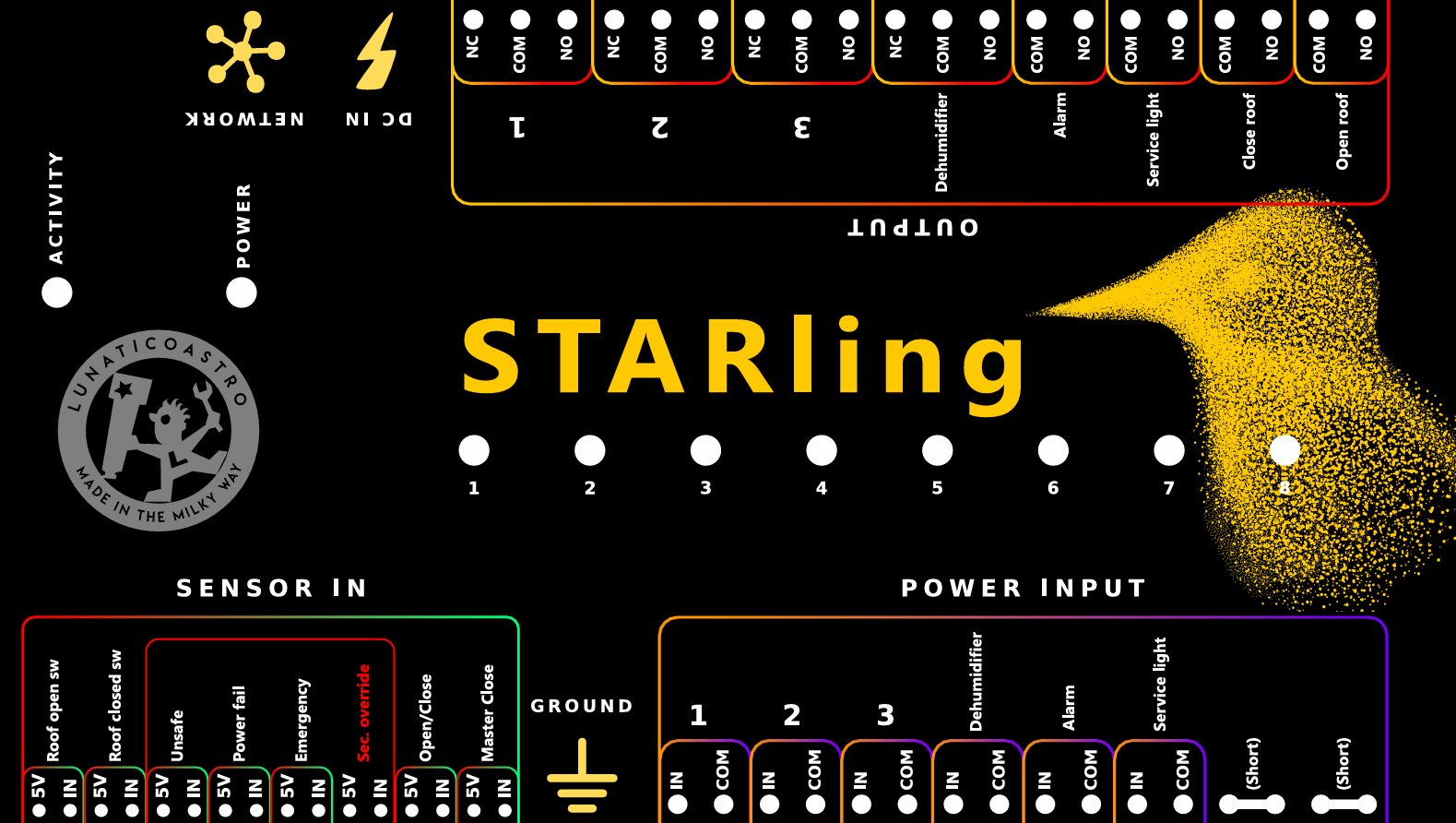
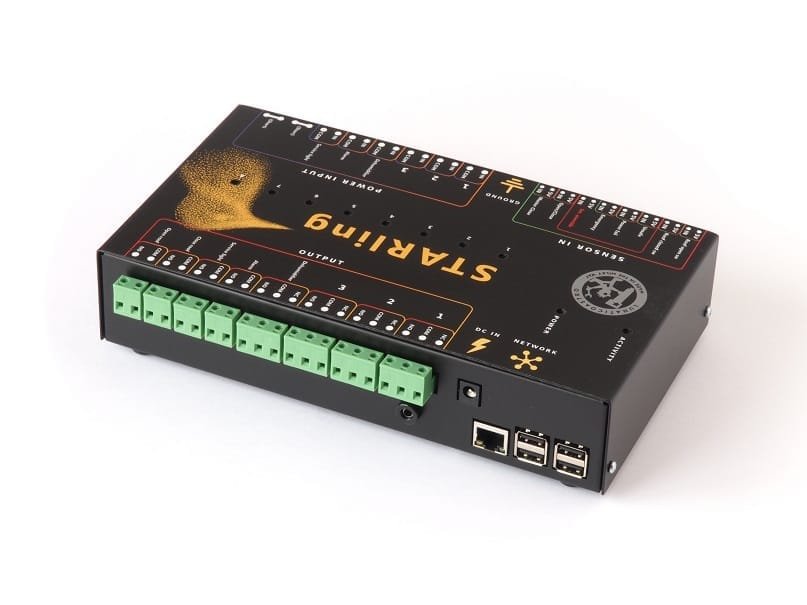
Hardware I/O Overview

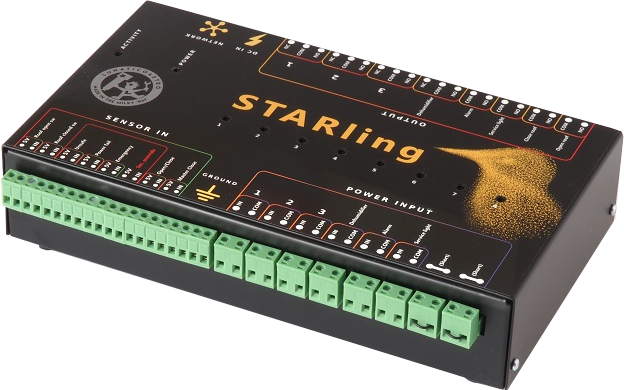
The connection label provides an at-a-glance overview of all sensor inputs and relay outputs, making installation straightforward and reducing setup errors in real observatory environments.

Starling Hardware I/O Overview

Inputs (IN)

  • Roof open switch

  • Roof closed switch

  • Unsafe

  • Power fail

  • Emergency

  • Security override

  • Open/Close

  • Master Close (forced close authority)

Relay outputs

  • 5 pre-assigned relays for typical observatory loads:

      • Dehumidifier

      • Alarm

      • Service lights

      • Open roof
      • Close roof
  • 3 free relays for custom functions

      • 2 of them can be assigned to control roof flaps

Lunatico Astronomia Starling multi-observatory controller rear view
Lunatico's Starling shared observatories controller (front view).

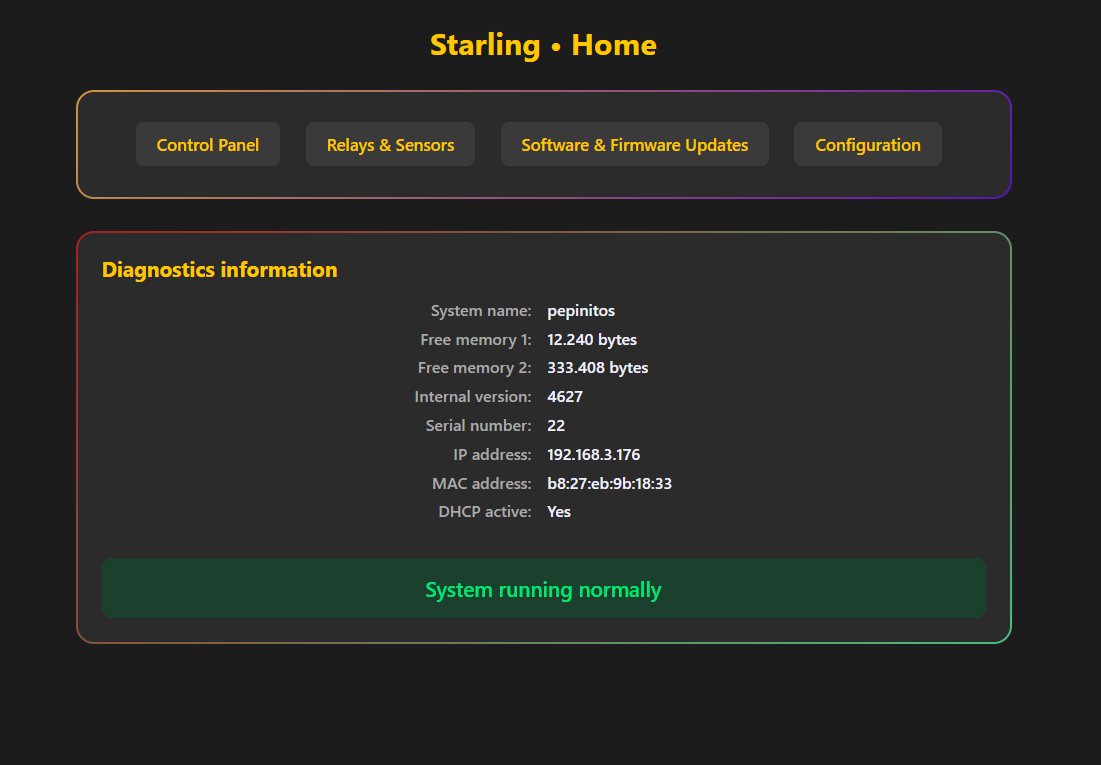
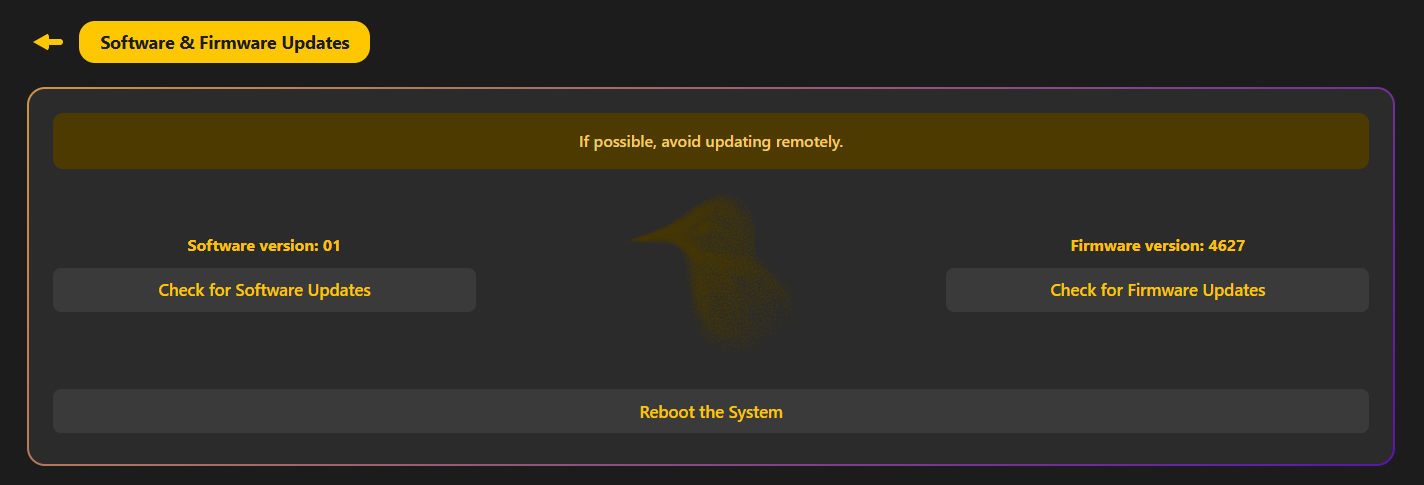
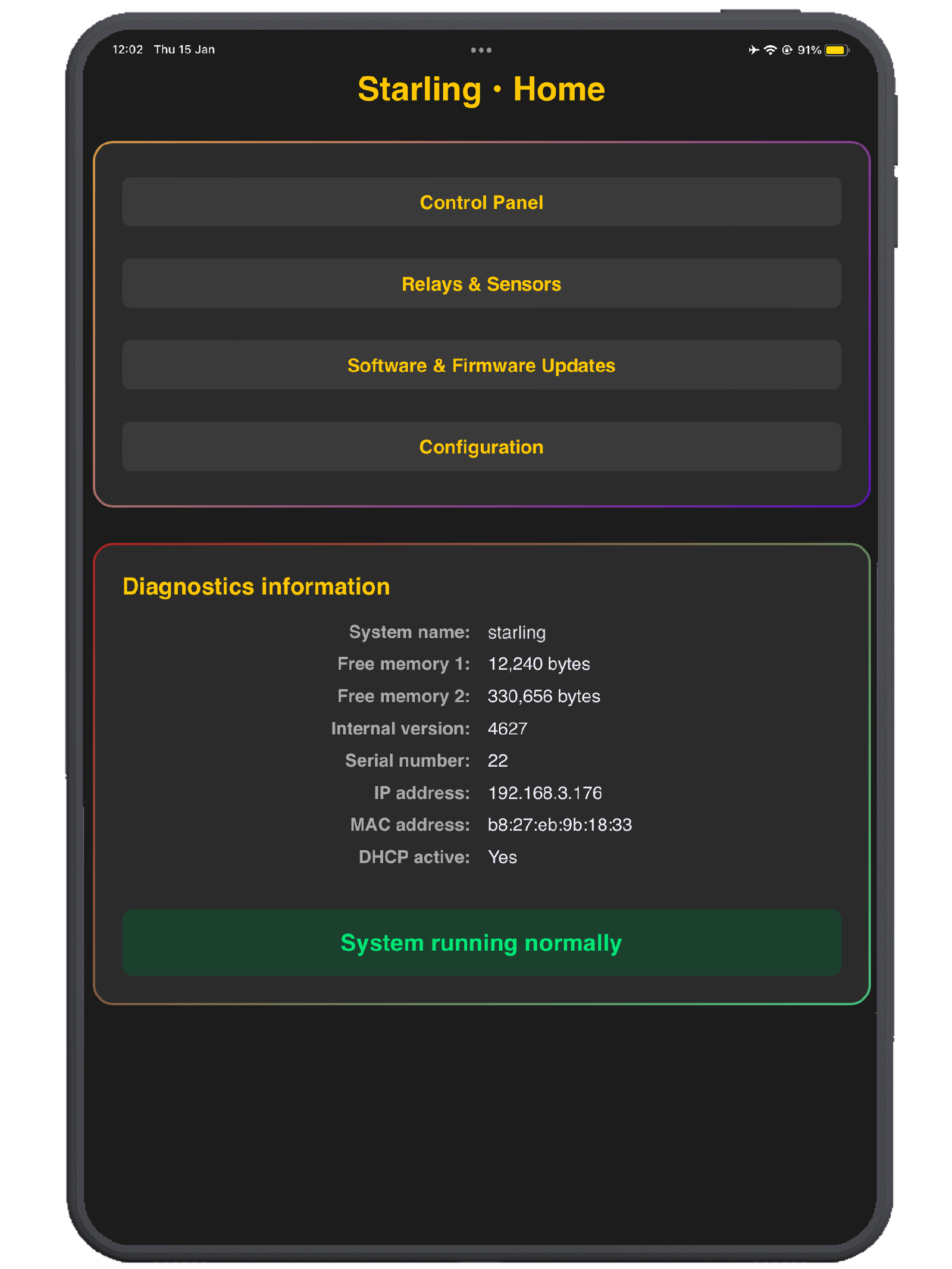
Starling web interface


Technical specifications:

Frequently Asked Questions

  • What is a shared observatory controller?

    A shared observatory controller is a system designed to allow multiple users to safely operate a single observatory infrastructure, coordinating access to the roof, sensors and safety systems without conflicts.

  • How does Starling manage multiple users in a shared observatory?

    Starling uses a role-based model with a Sentinel (observatory manager) and Clients (observatory users). Clients operate under a common access model, while the Sentinel supervises the system and can take over control when required, ensuring conflict-free operation.

  • Can Starling be used in professional observatories?

    Yes. Starling is designed for professional and semi-professional observatories, offering the robustness, reliability and versatility required for demanding installations and continuous operation.

  • Which types of observatory roofs can Starling control?

    Starling supports a wide range of roof systems, including roofs automated with Lunatico’s Caterpillar SSR, third-party motorisation systems such as garage door motors, and roofs driven by three-phase motors controlled via a VFD.

  • Can Starling be integrated with existing observatory software?

    Yes. Starling provides a simple API and ASCOM compatibility, allowing easy integration with existing astronomy software, control systems and custom workflows.

  • Do Sentinel and Clients need different devices to access Starling?

    No. Starling is accessed through a web-based interface available from desktop, tablet and mobile devices. Access permissions depend on the user role, not on the device used.

  • Is Starling suitable for remotely operated observatories?

    Yes. Starling is designed for remote observatory operation, providing safe roof control, system monitoring and integration with third-party software in shared and unattended environments.