
Firstly, a bit of background—feel free to skip to Section 3 if you're confident in your knowledge about relays and the like.
A relay is a very useful device indeed—being an electrically operated switch, it enables appliances such as our Dragonfly to turn on and off other appliances.
Let's compare relays and push buttons
- Every relay has two sides: the control side (your finger, able to push or release the button) and the proper switch (the internals of the push button opening or closing the circuit).
- The most common push buttons leave the circuit open if nobody is pushing them, and close the circuit when pushed (push buttons working the other way around also exist). These most common push buttons are called "normally open": they are open until some effort is made to change the state. The other model is called "normally closed".
- The same applies to simple relays: they can be "normally open" or "normally closed". When a relay is unpowered, it is in its normal state. When it is powered (power is applied to the control side, that is, like a finger push), the state changes. If we name the contacts of the relay IN and OUT, when the relay is closed, current will flow between IN and OUT, because internally IN and OUT will be connected. Conversely, if it's open, no current will flow.
So, a normally open relay won't allow current flow unless powered, and a normally closed relay will allow current flow unless powered.
3-contact relays
So far, so good. But some relays are a bit more complex (and useful!). They have 3 contacts—let's think of them as IN, NO (for normally open) and NC (for normally closed). The unpowered or relaxed relay will have IN connected to NC—with the ability to change this connection, and short IN with NO when powered (breaking, of course, the IN to NC connection).
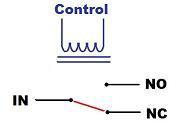
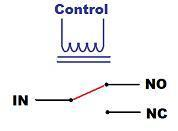
For added flexibility, the Dragonfly uses both kinds of relays.